
The cybersecurity story of the week comes from Italy. On Tuesday 10 November Interior Minister Matteo Piantedosi convened the National Committee for Public Order and Security at the Viminale, the Interior Ministry, to examine the public-safety risks of cyberattacks. Around the table were the heads of the police forces, the intelligence services and the National Cybersecurity Agency (ACN).
It is unusual for a committee built around public order to meet on a cyber threat: the signal is that attacks are no longer seen as a purely technical problem.
Why it was convened
The meeting followed a week of very different incidents, which Il Post listed in order:
- 2 November, supermarket fridges. The systems that control fridges and cold rooms in more than a hundred supermarkets across Europe were tampered with, including stores in Sicily and Tuscany. Pro-Russian groups NoName057(16) and Z-Pentest claimed the attacks. In most cases the attackers abused old equipment that had never been updated: we covered it in a dedicated article.
- Hoax bomb threats against more than 30 flights in Italy and Europe, none of them real.
- The personal data of Foreign Minister Antonio Tajani published on the dark web.
So far no authority has openly linked these incidents to each other.
What was decided
According to reports of the meeting, which lasted about two hours, the Interior Ministry will step up monitoring of the most vulnerable IT systems, with more coordination between investigations, more information sharing and investment in protecting systems.
No action plan has been published, though: no list of systems to check, no requirements and no deadlines. For now it is a stated priority, and its effect will depend on how it is put into practice.
What the ACN figures say
One number circulated around the meeting: almost 45,000 systems at risk. It comes from the ACN director's hearing at the Italian Senate on 13 October and covers the first nine months of 2026. It needs careful reading: a system "at risk" is a server, device or service that is exposed or vulnerable, not a breached machine.
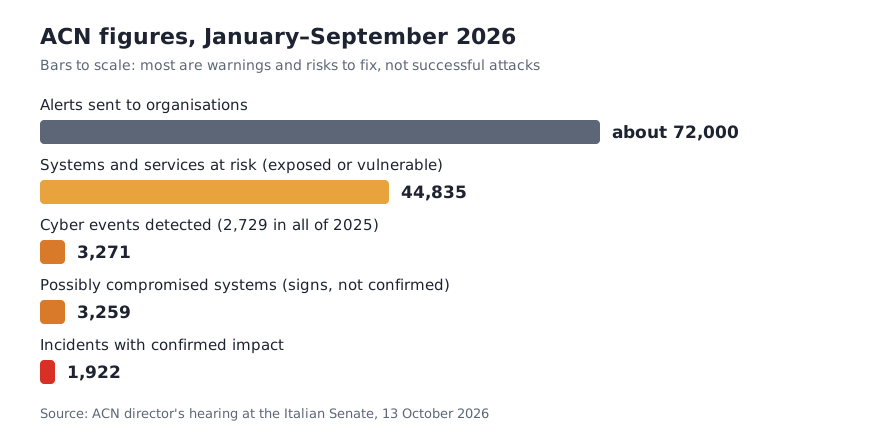
The picture is clear: for every real incident there are dozens of systems left exposed or unpatched. The events detected in nine months (3,271) already exceed those of the whole of 2025 (2,729).
A concrete example arrived on Friday 13 November: CSIRT Italia, the national incident response team, reported that a flaw in Apache Axis 1.x (CVE-2026-90436, CVSS 9.8) is being exploited in the wild. It lets anyone, without authentication, run code on the server with a crafted SOAP request. Axis 1.x is end of life: no update will be released, only a fix to apply by hand, and the ACN recommends migrating to Apache Axis 2. It is a Java library often buried inside old business applications, where nobody remembers it is there.
What it teaches anyone running a network
- Inventory what can be reached from the Internet, including what isn't "IT". Fridge controllers, HVAC systems, cameras and vendor management panels are networked just like servers, but often nobody treats them as part of the company network.
- Keep a list of end-of-life products, libraries included. An unsupported firewall is easy to spot; a library like Axis 1.x inside a ten-year-old application is not. Each one needs a plan: replace it, isolate it, or at least apply the manual fix when there is one.
- Never expose management interfaces directly. Reach them only through a VPN with multi-factor authentication, even when it is a vendor asking for access.
- Follow your national CSIRT's alerts. In Italy the ACN publishes daily alerts on exploited flaws and has already sent tens of thousands of targeted notices to exposed organisations: if you get one, treat it as urgent.
- Prepare users for fake messages. In the same week CSIRT Italia reported a new SMS campaign impersonating PagoPA and the SEND notification service to steal personal and card data: a heads-up to colleagues costs little.
The other stories of the week
- OpenSSH on Alpine is now exploited. The OpenSSH flaw on musl-based systems we wrote about last week was used in real attacks within hours of disclosure, and CISA added it to its list of exploited vulnerabilities. The fix is OpenSSH 10.6p2: if you run Alpine containers with password-based SSH, update now.
- An Outlook flaw already exploited in November's Patch Tuesday. Among Microsoft's 10 November fixes is one for Outlook that attackers were already using: prioritise the Microsoft 365 Apps and Office updates.
- Vanderbilt: "shut down every computer". On 9 November the US university told students and staff to shut down their devices and disconnect from Wi-Fi during a ransomware attack: a drastic but fast containment move.
- GitBook taken offline for hours after an intrusion. The documentation platform rotated every key, its own and its customers', after an attacker posed as staff by abusing a flaw in its single sign-on login. If you connect it to GitHub or GitLab, rotate your integration secrets.
Sources: AGI, the committee is convened (Italian) · Cybersecurity360, the outcome and the ACN figures (Italian) · Il Post, the week of attacks in order (Italian) · CSIRT Italia, the Apache Axis alert (Italian)