The second cybersecurity story of the week hits close to home: a campaign of attacks against the refrigeration systems of supermarkets, warehouses and healthcare facilities, which has also reached Italy. Attackers get into the controllers that run cold rooms and change temperatures remotely.
On 5 November CISA and the FBI, together with the US Departments of Health, Agriculture and Transportation, published a joint advisory. In Italy the National Cybersecurity Agency (ACN) had already asked food retailers to urgently check their remote access, and repeated the warning in early November.
What happened
- October, France. Attackers take over the refrigeration systems of hundreds of supermarkets (an estimated 250 to 350, according to BleepingComputer) and remotely trigger defrost cycles. CERT-FR, the French government response team, issues an alert on 12 October.
- Night of 1–2 November, France. Through a refrigeration equipment supplier, the cold rooms at three sites of the Établissement français du sang, the public blood agency, are reprogrammed: rooms running at about −30 °C get a setpoint of +110 °C. The agency disabled remote access, moved the plasma bags to other facilities and says there were no losses and no harm to patients.
- November, second wave. According to the US advisory and the trade press, more than 115 stores in six European countries: some systems shut down, others reached 50 °C.
- Italy. Police are investigating two incidents at food retailers, in Sicily and Emilia-Romagna.
Two pro-Russian groups, NoName057(16) and Z-Pentest, claimed attacks on European supermarket refrigerators, Italy included, in a video. The claim is unverified and there is no evidence linking these groups to the blood agency attack. The Kremlin rejects the accusations.
Why it works
No sophisticated vulnerability is needed. According to the CISA and FBI advisory and to ACN, attackers exploit:
- controllers reachable directly from the Internet, often for the convenience of technical support;
- outdated or no longer updatable software, because the product is out of support;
- weak configurations: default passwords, no limits on the temperatures that can be set;
- in some cases authentication bypass and code injection flaws in the controllers.
The blood centres case also shows the supply chain risk: the agency itself was not attacked, the company managing its equipment remotely was.
How to defend
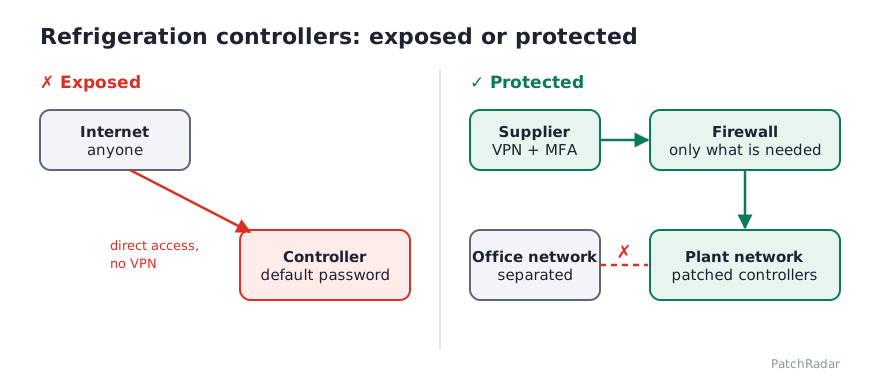
These apply to refrigerators, but also to boilers, HVAC, UPS units and every "OT" device, the ones that control machines and plants:
- Inventory the systems. Know which controllers you have, who manages them and how they are reached. Often the maintenance company installed them and nobody in-house knows.
- Take them off the Internet. No management interface should be directly reachable: check with an external scan or services such as Shodan.
- Controlled remote access only. VPN or brokered access with multi-factor authentication, with session logs and a list of authorised suppliers.
- Remote access switched off when not needed. Where possible, access is opened only for the job and closed right after: the supplier asks, someone in-house enables it for the duration of the work (ideally with automatic shutoff after a few hours). Access that is switched off cannot be attacked, not even through a vulnerability nobody knows about yet. Temperature alarms only need an outbound notification, which does not require leaving inbound access open.
- Change default passwords and apply available updates. If the product no longer receives updates, isolate it completely or replace it.
- Separate the plant network from the office network, with firewall rules that only allow the traffic that is needed.
- Set temperature limits on the controller, so that not even a remote command can push a cold room outside safe values.
- Ask your suppliers how they protect their access: is it written in the maintenance contract?
Sources: BleepingComputer, the CISA and FBI advisory · TechCrunch · Cybersecurity360, the blood agency attack (Italian) · ANSA, ACN and the Italian cases (Italian)