
The cybersecurity story of the week is the theft of about $6.3 billion from Binance, the world's largest cryptocurrency exchange. It is the largest crypto theft ever recorded. On 31 October the FBI attributed it to TraderTraitor, a group linked to the North Korean state.
It matters even if you never touch cryptocurrency: the attack did not start from an exotic vulnerability, but from techniques that can hit any company.
How it happened
According to the initial report Binance published on 3 November, the attack lasted months and involved the computers of three engineers:
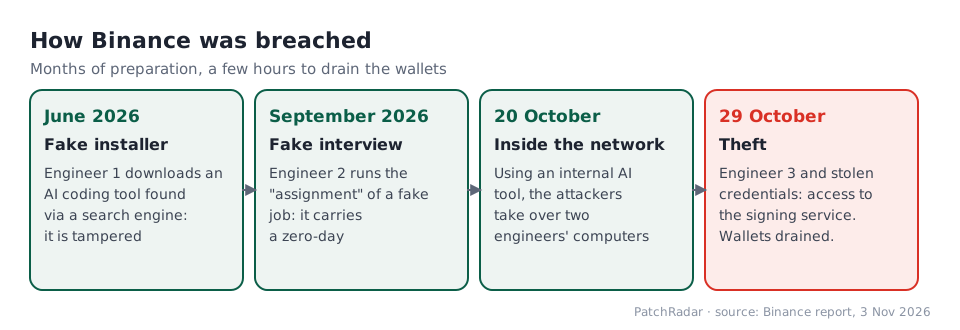
- June. An engineer on the wallet team searches for an AI coding tool on a search engine and downloads a tampered installer. Binance spots it and replaces the laptop, but the attackers have already gathered information about the infrastructure.
- September. A second engineer is approached for a fake job: two interviews, with a fake recruiter and the fake CEO of a non-existent company, then a coding "assignment" to download. The code carries a zero-day exploit that the company's endpoint protection does not detect.
- 20 October. From the infected machine, and by abusing an internal AI tool, the attackers take over two engineers' computers.
- 29 October. They get into a third engineer's computer, start a container with credentials stolen from the first one and reach the internal service that signs transactions. From there they drain the "hot" wallets (always online) in XRP, Solana, Optimism and Bitcoin.
The wallet was protected with distributed signing (MPC): precisely because of this there was no single key to revoke access immediately, and stopping the attack took hours.
How much was stolen and recovered
Figures are still provisional and vary between sources: about $6.3–6.4 billion according to Binance and the analytics firms Elliptic and TRM Labs. Between $2.7 and 3 billion has been frozen or seized. According to Elliptic the rest moved through about 12,000 addresses on 11 blockchains in less than four days.
The direct impact on users was limited: Binance covered the losses with its own funds, paused withdrawals and gradually reopened them from 1 November. On the day of the news Bitcoin fell almost 5% and Binance's own token (BNB) almost 10%. North Korea rejected the accusation.
What it teaches anyone running a company network
- Interview assignments never run on a work computer. A coding test received from strangers belongs, if anywhere, in an isolated virtual machine, never on the laptop used to reach company systems.
- Download tools from the official site, not the first search result. Fake installers advertised on search engines are a common attack channel: prefer package managers with official sources or an internal list of approved software.
- Internal AI tools are privileged accounts. If an assistant can read code and credentials or run commands, treat it like an administrator: least privilege, logged access, no secrets it does not need.
- Keep critical systems apart from developer laptops. Operations that move money, or change firewalls and VPNs, should require approval from a device other than the one used every day.
- Prepare the "red button" in advance. At Binance the MPC protection made it slower to stop the attack: for every critical system, know beforehand who can revoke access and how fast.
Other news of the week
- Attacks on supermarket and blood bank refrigeration. Cold rooms tampered with remotely in hundreds of European stores, Italy included: see our dedicated article.
- OpenSSH on musl-based systems. On Linux distributions that use the musl library without PAM, such as Alpine-based Docker images with SSH enabled, some locked accounts accept any very long password. If you run password-based SSH in Alpine containers, update OpenSSH as soon as a fix is available or disable password logins.
Sources: SecurityWeek, Binance's report · Infosecurity Magazine, the FBI attribution · ANSA, ACN on refrigeration (Italian) · musl mailing list, the 256-byte limit