
The most serious flaw of the week affects the Cisco Secure Email Gateway, the physical or virtual appliance that many companies put in front of their mail server to filter spam and malware. It is CVE-2026-76461, it has a CVSS score of 9.8 out of 10, and it lets an attacker run commands as root on the gateway by sending it an email: no password is needed and no user has to click anything.
Cisco published it on 14 September, when it was already being exploited in real attacks. This week's news is that public exploit code has appeared online: on 31 October Cisco released an updated version of the fix for release 15.5.5-014, and on 3 November it updated the advisory. Even those who have already upgraded must check that they have the new fix.
What happens
The gateway parses every email it receives. According to Cisco, the parsing code does not validate the content enough: an attacker can hide SQL statements in the email, and the gateway runs them. From there the attacker can run commands on the operating system with root privileges, that is, full control of the appliance.
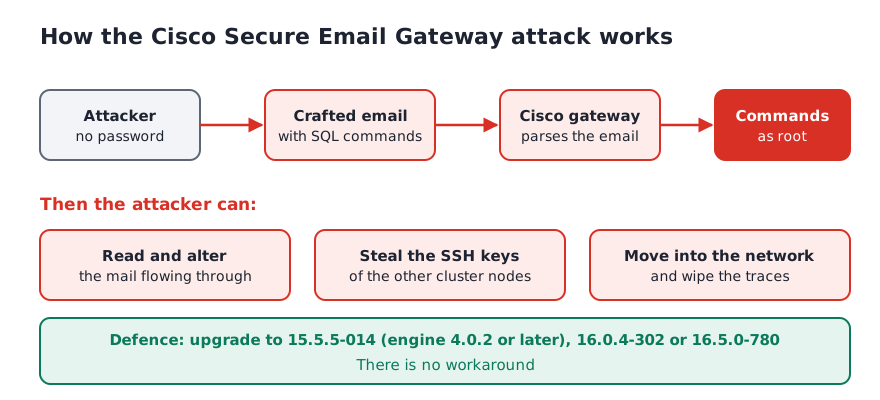
Cisco warns about two consequences in particular:
- with root access, an attacker can delete or hide the traces of the attack in the gateway logs;
- if the gateway is part of a cluster, the attacker can take the private SSH keys that the nodes use to authenticate to each other.
Who is affected
All Cisco Secure Email Gateway appliances, physical and virtual, regardless of configuration. Secure Email and Web Manager and Secure Web Appliance are not affected. The gateways of the Cisco Secure Email Cloud service have already been upgraded by Cisco.
| AsyncOS release | First fixed release |
|---|---|
| 15.5 and earlier | 15.5.5-014, with Cisco Retro Remediation Engine 4.0.2 or later |
| 16.0 | 16.0.4-302 |
| 16.5 | 16.5.0-780 |
Cisco recommends moving to 16.5.0-780 for anyone running a release earlier than 16.5: it is fixed regardless of the Retro Remediation engine.
What to do
- Upgrade now, from System Administration > System Upgrade in the web interface or with the
upgradecommand in the CLI. The gateway reboots at the end. There are no workarounds: upgrading is the only defence. - Look for signs of attack. Cisco suggests searching the mail logs for suspicious SQL statements, for example with
grep -i "COPY.*TO PROGRAM"onmail_logs, on every node of the cluster. Any result may indicate an attack. - Look outside the gateway too. Since an attacker with root can clean the logs, Cisco recommends checking the firewall and network logs: unexpected uploads from the gateway to external addresses, downloads from malicious addresses.
- If you suspect a compromise:
- on a physical appliance, Cisco says to contact TAC support;
- on a virtual appliance, Cisco says to first preserve logs and data for analysis, then deploy a new machine with a fixed release, rebuild the configuration and renew the credentials and certificates stored on the gateway.
On PatchRadar you can find the advisory page, the versions by branch in Cisco Secure Email (for example 15.5 and 16.0) and every flaw already exploited in Exploited now.
Sources: Cisco, security advisory cisco-sa-esa-inj-2bLVGmhX · CISA, KEV catalog · NVD, CVE-2026-76461